Interview

Sailing Toward Solutions

A Conversation with Emily Penn

For Emily Penn, the ocean has never been simply a place to sail across. It is a living system, a classroom, and a call to action. A sailor, ocean advocate and founder of eXXpedition, Emily has spent her career connecting people with the plastic crisis through science, storytelling and action. In conversation with Kensington Expeditions, she reflects on the journey that changed her life, why citizen science can accelerate solutions, and how purposeful travel can help people discover their own role in protecting our blue planet.

“We do not need everyone to do everything; we need everyone to do something”

— Emily Penn

A New Chapter for eXXpedition

LOOKING AHEAD

A New Chapter for eXXpedition

When Emily Penn joined our conversation, she was at the Düsseldorf Boat Show, speaking with sailors, yacht owners and ocean lovers about the blue planet and the next chapter of eXXpedition. After several years away from the water, partly due to the pandemic and partly because she started a family, 2026 marks a return to sea. eXXpedition is preparing voyages through New Zealand and the South Pacific, followed by the Arctic, Antarctica, the Caribbean and the North Pacific. For Emily, the excitement lies not only in the routes themselves, but in the mission that underpins them. The focus is clear: connect land and sea, identify the sources of plastic pollution, and gather the evidence needed to stop it at the source. Alongside the science, Emily is inspired by the diverse group of women joining the program, each bringing a different perspective, skill set and sphere of influence.

A LIFE AFLOAT

From Dinghies to Ocean Gyres

Emily’s relationship with the ocean began in childhood. She grew up sailing small racing dinghies, starting in what she describes as little more than a bathtub with a sail, before progressing to racing skiffs and competing for Britain as a teenager.

Her career, however, was originally pointed in a very different direction. She studied architecture and had a job lined up in Australia, but decided she wanted to travel there from the UK without flying. That decision led her to Earthrace, a biofuel-powered vessel that had broken the round-the-world speed record and was setting off on a global promotional tour for renewable energy.

Emily wrote to the skipper, joined the boat in Brighton for a weekend, and did not go home for 933 days. What began as an unconventional journey to Australia became the experience that reshaped her life.

When Plastic Became Visible

TURNING POINT

When Plastic Became Visible

In 2008, while crossing the Pacific, Emily jumped overboard for the crew’s daily wash. They had no running water on board. Eight hundred miles from land, she found herself surrounded by a toothbrush, a cigarette lighter and a bottle top.

At the time, plastic pollution in the open ocean was not widely discussed in the news or in documentaries. It almost felt like a mistake. But as the journey continued, Emily encountered remote islands covered in plastic, both washed ashore and generated locally. She saw communities facing depleted fish stocks, rising sea levels, changing crops and increasing reliance on imported packaged food, often without the infrastructure to manage the waste that followed.

By the end of the journey, Emily knew she would not be taking the architecture job. Instead, she stayed with the issue, helping lead a major cleanup project in Tonga, contributing to the first global study of the five ocean gyres, and eventually founding eXXpedition.

MISSION EVOLVED

Science, Storytelling and Action

Today, eXXpedition’s purpose is to connect people with the plastic crisis so they can discover their own role in tackling it. The work rests on three pillars: science, storytelling and action.

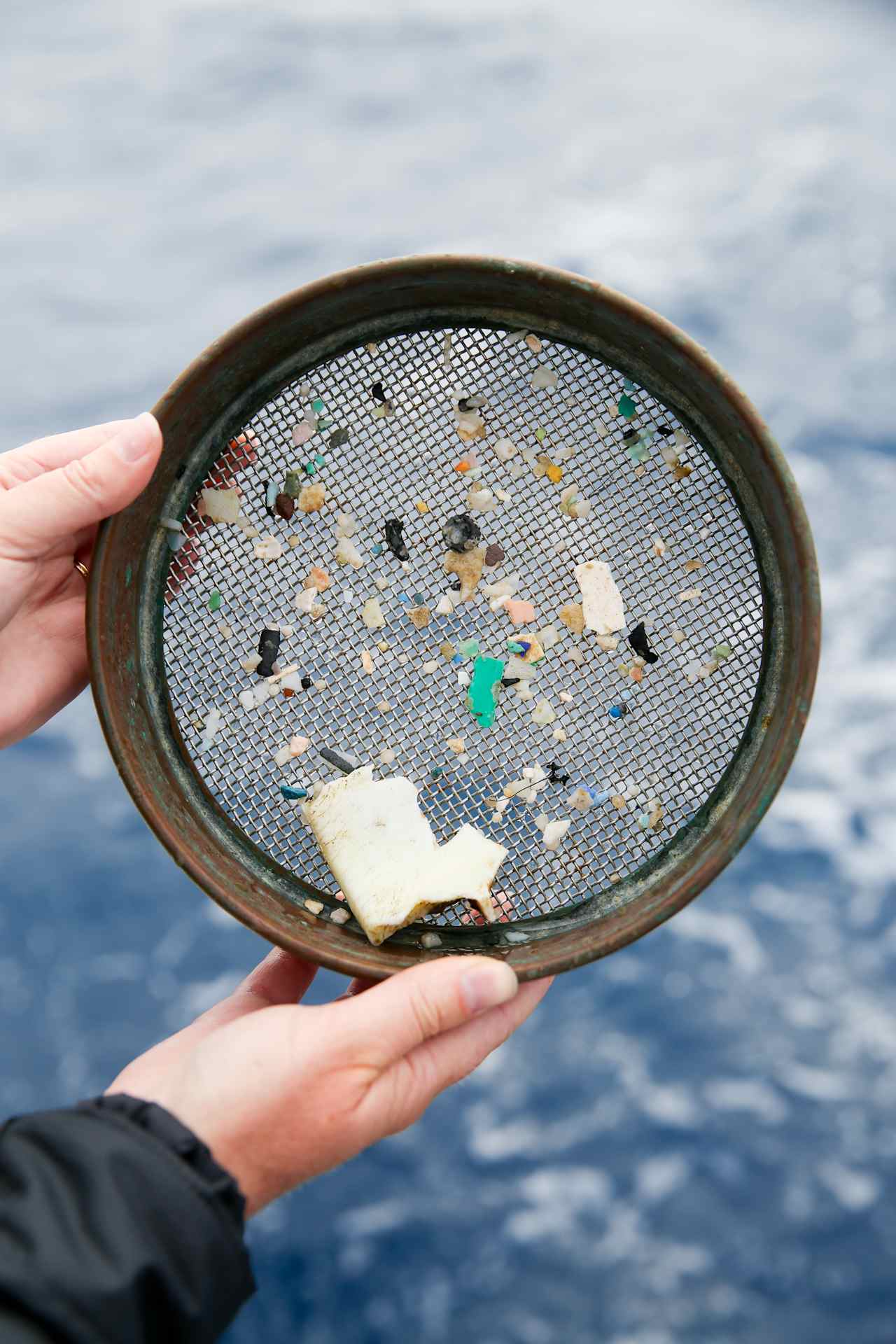
Over the past decade, the science has evolved significantly. Early expeditions searched for visible accumulations of plastic. Then came the focus on microplastics, as larger pieces broke down into smaller fragments. When those fragments were found entering the food chain, the work expanded to include toxic chemicals and the way they might move through the environment and into living systems.

Now, the mission is increasingly focused on solutions. By looking for patterns between the plastic found on land and at sea, eXXpedition aims to identify where pollution is coming from and provide evidence that governments, businesses and individuals can use to act.

“That connection to the ocean, nature, the stars and the planet is incredibly powerful.”

More Than Observation

TRANSFORMATIVE TRAVEL

More Than Observation

For Emily, the voyages themselves are deeply transformative. On a previous expedition aboard a 72-foot yacht, she took scientists from Woods Hole Oceanographic Institution to study ocean acidification in the central Pacific. One marine scientist, despite a career spent aboard major research vessels, was steering at two in the morning beneath a sky filled with stars and shooting stars. He turned to Emily and said, “Today feels like my first night at sea.”

That sense of connection is central to eXXpedition. Participants do not simply observe from the sidelines. They help run the vessel, take part in workshops, engage with local communities and contribute directly to the scientific mission.

It is this blend of ocean immersion, credible research and hands-on participation that makes the experience so powerful. The voyage becomes not only a journey through a place, but a catalyst for personal responsibility and long-term action.

CITIZEN SCIENCE

Discovery in Everyone’s Hands

Citizen science can take many forms, from community reporting apps to local monitoring projects. eXXpedition’s model is distinct: it brings people who are not necessarily trained scientists into controlled research environments, enabling them to work with sophisticated equipment and contribute to credible data collection.

This approach creates a powerful exchange. Participants gain a valuable and often life-changing experience, while their involvement helps fund scientific research that might otherwise be difficult to carry out.

There is also a deeper educational effect. When participants examine, classify and log individual pieces of plastic, patterns begin to emerge. A particular wrapper found repeatedly on a beach, or plastic linked to fish farms in a specific region, turns a global crisis into something local, visible and actionable.

EVIDENCE INTO CHANGE

From Research to Policy

Turning science into policy is difficult. Emily is candid about the challenge, particularly in relation to the long and often disheartening negotiations around a global plastics treaty.

Part of the difficulty is that plastic pollution does not have one universal solution. What works in one location may not be relevant in another. Much of the nuance can be lost when the issue is addressed only at a global level.

For that reason, eXXpedition’s science is becoming increasingly local and place-based. When data can show exactly what the problem is in a particular city, country or coastal system, it becomes much easier to identify the right intervention and influence meaningful policy. The design of the scientific program, and the data it collects, directly shapes whether practical change can follow.

Why the Ocean Can Recover

REASONS FOR HOPE

Why the Ocean Can Recover

Despite the scale of the challenge, Emily is clear that there are reasons for optimism. In the UK, plastic bag consumption fell dramatically after the introduction of the five-pence charge, showing how a relatively simple legislative change can alter behavior at scale.

She also recalls returning to remote coral reefs in the central Pacific that had been badly bleached during an El Niño event in the 1990s. Seven years later, those reefs had recovered and were thriving.

The key was that they were remote. With no local fishing pressure and no pollution, they had the space to bounce back. For Emily, this is one of the ocean’s most important lessons: when pressures are removed, recovery can be abundant and extraordinary.

YOUR SUPERPOWER

Everyone Can Do Something

Emily encourages people to think beyond neutrality and toward being net positive. Each of us has a sphere of influence, whether in a workplace, a school, a community, a family office, a company or a creative field. That sphere is where meaningful change can begin.

She calls this your superpower. It may be redesigning a product, changing a supply chain, choosing venues differently, telling stories in a new way or influencing how a business buys, builds or behaves. The point is not that everyone must do everything. It is that everyone can do something.

“Everyone has an area where they have influence or expertise, their superpower, and can use it to create change.”

A Role for Travelers and Yacht Owners

OCEAN ADVOCATES

A Role for Travelers and Yacht Owners

Looking ahead, success for eXXpedition would mean running expeditions year-round across the globe in many different formats. Sailing will remain important, but so might paddleboards, coastal hikes or journeys along rivers. The common thread is science, storytelling and transformative experience.

Emily also sees a natural role for boat owners and travelers. People usually own boats because they love the water, which makes them natural advocates for ocean protection. Travelers, particularly those visiting small island communities with limited waste-management systems, can make more thoughtful choices about what they bring, buy and leave behind.

On board, that might mean provisioning in bulk, baking rather than buying individually wrapped products, using gentler cleaning products and remaining conscious of where waste and wastewater go. Living close to nature makes the consequences of our choices immediate.

Become Part of the Change

For those drawn to travel with purpose, there may be opportunities to engage more deeply with the work of Emily Penn and eXXpedition.

Select clients may be able to support ocean discovery, witness active research or explore bespoke ways to connect with citizen science and ocean protection first-hand, subject to timing, suitability and availability.

Contact us for a private consultation
Become Part of the Change
Start Planning